AI Dental Analytics: The Complete Guide for Dental Practices (2026)
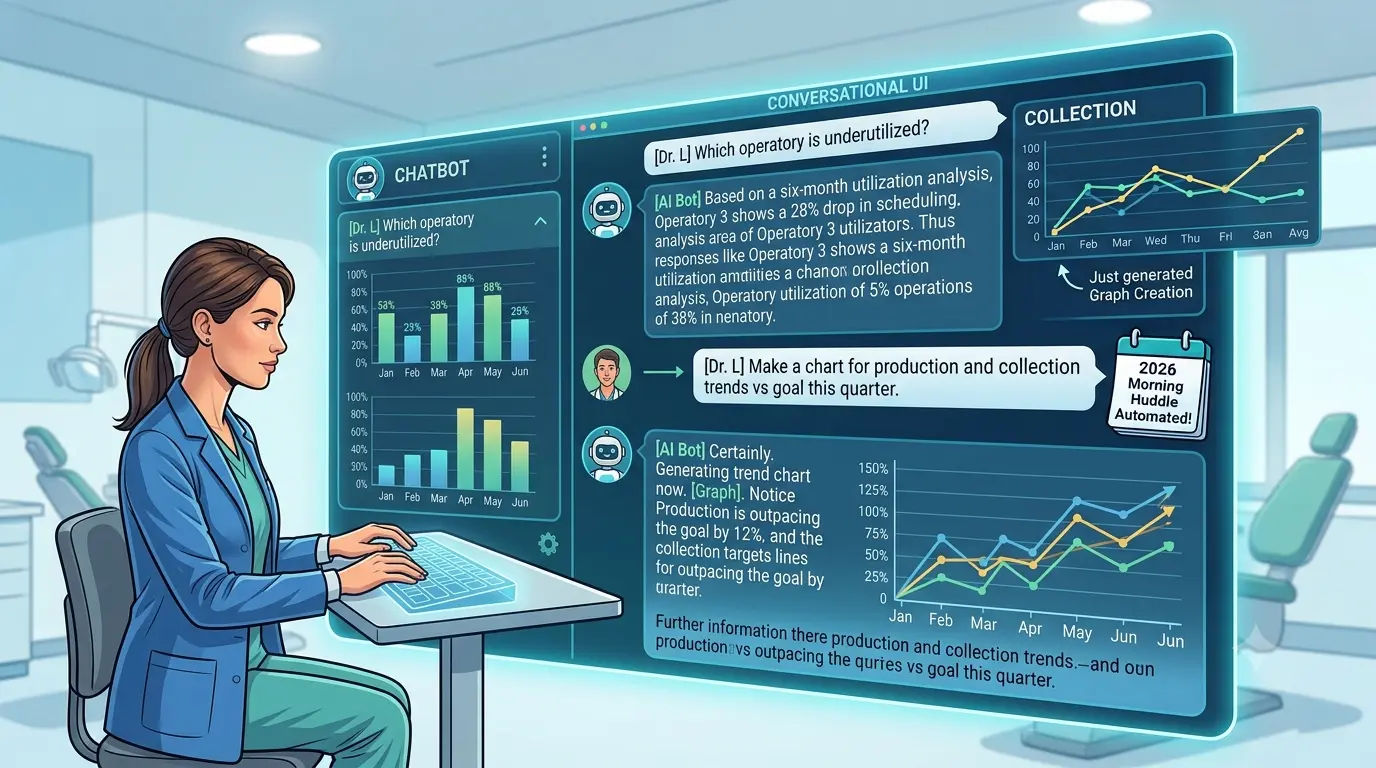
Most dental practices are sitting on years of data — production numbers, hygiene recall lists, call logs, treatment plans — and almost none of it gets used. Not because the data isn't valuable, but because getting answers out of a practice management system means pulling reports, exporting spreadsheets, and interpreting charts nobody has time to read.
AI dental analytics changes the mechanics of that. Instead of building reports, you ask questions — "Which operatory is underutilized?" or "How did our no-show rate trend this quarter?" — and an AI analyzes your practice data and answers, with the charts and context to act on it.
This guide covers what AI dental analytics actually is, how it differs from the dashboards you may already have, what it can (and can't) do, and how to evaluate tools if you're considering one.
What is AI dental analytics?
AI dental analytics is the use of artificial intelligence to analyze a dental practice's operational and financial data and turn it into plain-language answers, visualizations, and recommendations.
Traditional practice analytics required a human to do the analysis: someone pulls the report, reads it, compares it to last month, and decides what it means. AI dental analytics moves that interpretive work to the software. The AI connects to your practice management system (PMS), phone system, and patient communication tools, and works across all of it at once.
Two distinct categories share this label, and it's worth separating them:
- Clinical AI analytics — AI applied to diagnostics: analyzing radiographs, detecting caries, supporting treatment decisions. Tools like Overjet and Pearl operate here.
- Practice AI analytics — AI applied to the business of dentistry: production, collections, scheduling, recall, call handling, and patient communication.
This guide focuses on the second category — the operational side, where most practices see the fastest return because it addresses revenue that's already leaking.
AI analytics vs. traditional dental dashboards
Dashboards aren't bad — they're just passive. A dashboard shows you what it was configured to show, and the interpretation is your job. The practical differences:
| Traditional dashboard | AI (agentic) analytics | |
|---|---|---|
| Getting an answer | Find the right report, filter it, interpret it | Ask a question in plain English |
| Coverage | Fixed KPIs chosen in advance | Any question your data can answer |
| Interpretation | You read the chart and decide what it means | AI highlights what changed and why it matters |
| Surfacing problems | Only if you look at the right report | Flags anomalies proactively (e.g., an underutilized operatory) |
| Effort over time | Someone has to keep checking | Daily briefings arrive automatically |
The industry term for the question-driven approach is agentic analytics — the AI acts as an agent (a data analyst on your team) rather than a static reporting layer. In practice, most practices want both: dashboards for the KPIs you check every day, and an AI you can interrogate when a number looks off.
What can you actually ask?
The value of AI dental analytics is easiest to see in the questions it answers without anyone building a report:
Revenue and production
- "Show me revenue trends for the last 6 months."
- "Which operatory is underutilized and costing me production?"
- "How does production per hour compare to our goal?"
Scheduling and patients
- "Compare no-show rates across all locations."
- "What are our busiest appointment times?"
- "Which patients are overdue for hygiene recall?"
Communication and marketing
- "Which campaigns have the highest ROI?"
- "How much of our inbound call volume is handled by AI vs. staff?"
- "What's our average response time to patient texts?"
Each answer comes back as a chart or summary with the relevant context — not a raw export you still have to make sense of.
How it works: where the data comes from
AI dental analytics is only as good as the data feeding it. A complete picture requires three layers:
- Your PMS — production, collections, schedules, treatment plans, recall status. Integration with systems like Dentrix, Eaglesoft, Open Dental, and Curve Dental means data syncs automatically rather than through manual exports.
- Your phone system — call volume, missed calls, answer rates, conversion of calls to appointments. This is the layer most standalone analytics tools miss entirely.
- Patient communications — text response rates, campaign engagement, reactivation outcomes.
When all three are connected, the AI can answer cross-cutting questions no single-source dashboard can — like whether missed calls on Mondays correlate with your front desk's busiest check-in hour.
The morning huddle, automated
One of the most practical applications isn't a dashboard or a chatbot — it's a briefing. An AI morning huddle reads your PMS overnight and delivers a summary before the day starts:
- Priority tasks: overdue recalls, pending treatment plans, insurance verifications
- Today's schedule with per-patient flags (medical alerts, allergies, notes from the last visit)
- Gaps in the schedule worth filling from the recall list
Teams that run morning huddles already know the value; the AI version means nobody spends 20 minutes preparing it.
What to look for when evaluating tools
If you're comparing AI dental analytics options, these are the questions that separate genuinely useful tools from dashboards with an AI label:
- Does it integrate with your PMS directly? If data entry is manual, the analytics will always be stale.
- Can you ask free-form questions? Some tools market "AI insights" but only offer pre-built reports. Ask for a live demo where you pose your own question.
- Does it cover calls and communication, not just PMS data? Front-desk performance is invisible to PMS-only tools.
- Does it work for multiple locations? If you're a group or DSO, benchmarking across locations should be built in, not bolted on.
- Is it HIPAA-compliant? Patient data flows through these systems. Compliance is table stakes; ask how data is stored and whether it's used outside your organization.
- What does it cost relative to what it replaces? Standalone dental analytics platforms commonly run $200–500/month. Platforms that bundle analytics with communication and AI tools can change that math significantly.
Where Operaitor fits
Operaitor's approach is agentic analytics as part of an integrated platform: you ask questions about your practice data in plain English and get instant answers, charts, and an AI-generated morning huddle — alongside a classic dental KPI dashboard for production, collections, and multi-location reporting. Because Operaitor also runs your phones, texting, and patient campaigns, the analytics see the whole practice, not just the PMS.
You can explore the full set of dental analytics solutions here.
Ready to see it live? Try asking your own practice data a question or book a demo.
Operaitor Team
Dental Practice Growth Experts
The Operaitor team combines dental industry expertise with AI technology to help practices grow. We share actionable insights on patient acquisition, practice management, and healthcare automation.
Ready to Automate Your Practice?
Join modern dental practices using Operaitor to answer every call, book more appointments, and grow 24/7.
No credit card required for demo